


Lee Edwards enjoying a romp on Blencathra's Sharp Edge
"This is a thoroughly enjoyable romp!" I effused to Lee, who undoubtedly raised an eyebrow at my choice of language and the volume at which I'd decided to proclaim my opinion of the situation. Herein lies the beauty of the grade one scramble: thrilling enough to get the adrenaline going but not so technical that the terrain slows you down to the pace of a rock climb. On this occasion, we were on Blencathra's classic Sharp Edge in the summer sun and romp was the word that I felt best described the experience... A scramble is a thrilling way to climb a mountain. At the point where progress becomes impossible without the use of your hands, you’re scrambling. Many of the best hikes in the UK contain such moments, while routes that contain sustained hands-on-rock action become named scrambles and are graded in terms of difficulty. Think Striding Edge, Aonach Eagach, Pinnacle Ridge etc etc. The higher the grade, the harder they are. A Grade 3 scramble is akin to a moderate rock climb and most people would choose to take ropes and a helmet. On the other end of the spectrum, a Grade 1 scramble is within the capacity of most adventurous hikers. It'll feature exciting terrain that can be moved through at relative speed, without the need for all the paraphernalia. This makes a grade one scrambling immensely liberating. Many of Britain’s finest mountain days feature a grade one scramble as their centrepiece, their headline act. We’ve chosen some of our favourites in the Lake District, Snowdonia and the Scottish Highlands. With airy, razor-sharp arêtes, thrilling climbs and huge views, our selection of the best Grade 1 scrambles in the UK contain life-affirming experiences.


Striding Edge
Possibly the most famous ridge in the UK, Helvellyn’s Striding Edge is a rite of passage. For many, this immensely popular route is their first taste of airy ridge walking and scrambling. Some vow ‘never again’; others are hooked for life.
Helvellyn’s eastern side is spectacular – a great glacial bowl with the gem of Red Tarn at its centre and two great arms on either side, Striding Edge to the south and Swirral Edge to the north.

Yours truly on a gloriously sunny day on Striding Edge
"Take your time and you’ll discover there are plenty of handholds and places to place your feet."
Striding Edge is the more spectacular of the two and its rocky crest gives fantastic entertainment and superb views. There’s a bypass path that avoids many of the difficulties but also misses out on a lot of the fun. The crux comes towards its western end, a rocky chimney that can be particularly tricky to downclimb. However, take your time and you’ll discover there are plenty of handholds and places to place your feet.
The route’s appeal is the way it balances accessibility with challenge. It’s just hard enough to feel like a proper adventure but it’s easy enough that most fit hikers with a head for heights can stride out along it with confidence. However, it is still an exposed ridge and should be avoided in poor or windy conditions.
Sharp Edge
Not quite as well-known but with an even spikier reputation, Blencathra’s Sharp Edge is a good progression from Striding Edge. Narrower and featuring more hands-on-rock action, this rugged crest arcs above Scales Tarn delightfully. It’s as though a giant has taken a great bite out of the mountain, leaving its rocky foundations exposed.
The first section is an involved rocky clamber, before things level out into an airy traverse that’s reminiscent of Striding Edge, with gut-wrenching drops on either side.

Lee Edwards towards the top of Sharp Edge
"It’s as though a giant has taken a great bite out of the mountain, leaving its rocky foundations exposed."
The only problem is, it’s all over too soon. The good news is that it can be combined with a descent of the excellent Halls Fell, making for a very satisfying outing on this icon of the North Lakes.
As with any narrow ridge, it’s a bad idea in high winds, while Sharp Edge is particularly dangerous in wet or icy conditions too. Popularity has led to much of the rock being very polished, making it very slippery when wet. One particular section, the Bad Step, is notoriously treacherous after rainfall and well-known to Mountain Rescue. This is why the gully to the side of the Bad Step is known as ‘the Usual Gully’. My advice is not to climb Sharp Edge when it's wet.
Jack's Rake
Pavey Ark’s great cliff dominates the northwestern end of Stickle Tarn, at the heart of Lakeland’s iconic Langdale Pikes. Across its face, conspicuous even from a distance, rises a diagonal ramp. It looks very intimidating, especially up close. Yet, amazingly, the climb across and up this mighty cliff is a mere Grade 1 scramble. This is Jack’s Rake.

Yours truly just before a wet ascent of Jack's Rake
"The sense of exposure is tangible, with massive drops to your left as you pick your way up."
A hugely rewarding scramble with nothing artificial when it comes to the purity of the line, ascend Pavey Ark via Jack Rake and you’ll really feel as though you’ve climbed a mountain. It’s not an airy ridge – unlike the other classic Grade 1 scrambles in this feature – but the sense of exposure is tangible, with massive drops to your left as you pick your way up.
It’s also more of a climb than the likes of Striding Edge and Sharp Edge, which are much more horizontal. However, the handholds and foot placements are solid throughout so any nerves present at the start of the ascent will evaporate as the enjoyment of the scramble takes over. Best of all, you top out onto one of Lakeland’s most stunning viewpoints.
Tryfan North Ridge
Rising like the spine of a gigantic, petrified monster from the Ogwen Valley, there are few sights to rival Tryfan. That line that rises diagonally and so enticingly from the A5 straight to its summit is the North Ridge – a legendary grade one scramble, possibly the finest in Britain. Let the masses climb Snowdon - you’ve got better things to do.
The magical thing about Tryfan’s North Ridge is that you’ll never do it the same way twice. You choose your line over this labyrinth of jumbled rock. This means it can easily be more technical, but any difficulties beyond grade one scrambling are totally avoidable. The line of least resistance is generally the crest of the ridge or far over to the right.

Tryfan North Ridge is a soaring line, a quite magnificent prospect
"Let the masses climb Snowdon - you’ve got better things to do."
The meat of the scramble takes place once you pass the Canon, a jutting, unmistakable prow of rock about halfway up. Boulder strewn gullies, rocky spurs and magnificent subsidiary summits are all experienced, before you finally arrive on Tryfan’s charismatic summit.
The final, optional (but then, isn’t everything in the mountains?) challenge is the leap between Adam and Eve, the twin rock monoliths that adorn the top of the mountain. A slip here could be fatal but fortunately the step between them is actually very easy once you calm your fluttering heart.
Descent is usually by way of the easier South Ridge, after which you have the option to continue the scrambling fun by ascending Glyder Fach’s Bristly Ridge.
Bristly Ridge
This is a phenomenal scramble that goes quite hard for the grade – I’d say it’s the trickiest outing in this guide and I can't think of another more difficult Grade 1 scramble. Two cruxes: Sinister Gully and the Great Pinnacle Gap require a few moves that can feel like proper rock climbing. However, the holds are huge and confident scramblers should have no trouble.
The route starts from Bwlch Tryfan between Glyder Fach and Tryfan. Finding the correct gully to begin the scramble is half the battle, as the alternatives are increasingly eroded and loose. I once narrowly missed having my leg broken by a large tumbling boulder after my party had chosen the wrong way up. Fortunately, I was able to react and lift my leg just in time and the boulder bounced harmlessly away.

Two unknown hikers towards the top of Bristly Ridge with Tryfan beyond
"I once narrowly missed having my leg broken by a large tumbling boulder after my party had chosen the wrong way up."
The gully you’re after is Sinister Gully. Follow the wall from the bwlch to the base of the crags, skirt right for 10 metres and climb up into a short gully, exiting left into another gully characterized by an obvious overhanging prow of rock halfway up. This is Sinister Gully and its ascent is thrilling, steep and full of juggy handholds.
Once the main ridge is gained, the going is reminiscent of Tryfan’s North Ridge and it gives great entertainment. The most stunning section is a distinctive notch in the ridge – the Great Pinnacle Gap. A careful downclimb finds you in its atmospheric jaws and then you climb up through an intricate groove system, before continuing on to bag Glyder Fach’s moonscape summit.
Crib Goch
In terms of infamy, Crib Goch is Snowdonia’s answer to Striding Edge and its reputation is more than deserved. Its elegant and deliciously narrow Main Ridge is the most exciting approach to Snowdon for hikers. Not only is it exhilarating, it’s also an incredibly aesthetic line, with stunning views towards Wales’ highest peak.
It’s certainly a step up in terms of difficulty compared to Lakeland’s famous edges and shouldn’t be attempted in poor conditions or when high winds are forecast. A fall could be fatal.
Most hikers approach Crib Goch via its East Ridge from Snowdon’s Pyg Track at Bwlch y Moch. Don’t get me wrong, this is a great approach and a fine scramble in its own right but, here, I’m going to bang the drum for the wilder and more exhilarating North Ridge.

Mirek Stiles on one of Crib Goch's superb pinnacles
"Trend to the left, as a fall to the right would be unthinkable."
Accessed by following a trail from the Llanberis Pass up into Cwm Glas Mawr or by taking the difficult Fox’s Path from Bwlch y Moch, it’s a captivating line that narrows towards its rocky apex and rewards with awesome views of the Main Ridge yet to come.
The arrival at Crib Goch’s east summit is magical, with the arête snaking away ahead, culminating in its superb pinnacles. The traverse is actually straightforward and foot placements are easy enough. Trend to the left, as a fall to the right would be unthinkable. Crib Goch’s first two pinnacles are usually bypassed, while an easy scramble to the right of the third pinnacle rewards with a glorious platform to view Snowdon’s summit pyramid.
CMD Arête
The Càrn Mòr Dearg Arête – commonly referred to as the CMD Arête – is the best way for hikers to approach Ben Nevis. Forget the tiresome zigzags of the Pony Track, if you’re of an adventurous disposition, this is the way to Britain’s highest mountain.
Hanging like a sagging washing line between the summit of Cárn Mòr Dearg and the Ben’s southeast shoulder, the Arête is an obviously awesome prospect. On a clear day, the view across Ben Nevis’ North Face is huge, as the guts of the mountain are revealed in all their sinister glory. Those who ascend the Pony Track never get to see this startling side of the Ben.

Tom Andrews and Sam Andrews on the CMD Arête
"The great news is that it’s longer than the likes of Striding Edge and Crib Goch, so the entertainment just keeps coming."
The scrambling isn’t difficult along the sinuous ridge, as you hop between large boulders. It’s not as narrow as Crib Goch and, as with Striding Edge, there’s often a bypass path too. However, crest is best. The great news is that it’s longer than the likes of Striding Edge and Crib Goch, so the entertainment just keeps coming.
This is a good thing too, as it entails a lot of effort just to access the ridge. Ben Nevis via the CMD Arête is a big mountain day, involving a hefty amount of elevation gain, so a good level of hill fitness is required. To access the ridge, you can either follow the Pony Track as far as the Halfway Lochan or approach from the North Face car park. Whichever you choose, it’s a long hike to the summit of Càrn Mòr Dearg, where the scramble begins.
The Horns of Alligin
Head for the far northwest and Scotland’s mountains take on more individualistic, primeval forms. Few places is this more apparent than in Torridon. Home to some of the oldest exposed land on the planet, Torridon boasts some of the finest mountain days you’ll find anywhere.
For those who’ve fallen under the region’s spell, it’s famous triumvirate of Beinn Eighe, Liathach and Beinn Alligin call from a great distance. Beinn Eighe and Liathach are serious outings, while Beinn Alligin – the Jewelled Mountain – has a gentler form. However, like a rose has thorns, Alligin has the Horns, a series of blunt sandstone pinnacles that are home to one of the most aesthetic Grade 1 scrambles in Scotland.
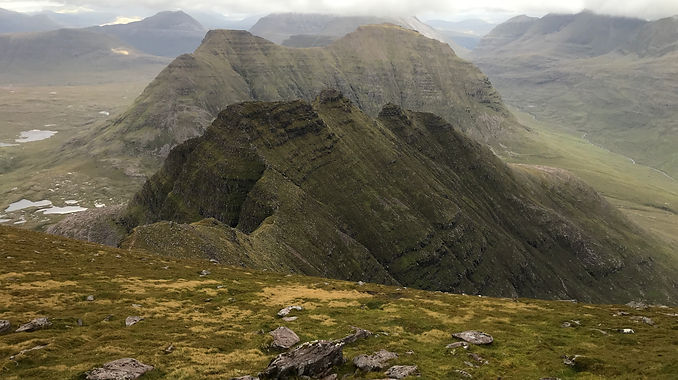
The Horns of Alligin rising in front of Beinn Dearg
"Like a rose has thorns, Alligin has the Horns"
It’s a sea level start, so you’ll soon have the heart pumping but the approach along the Allt a Bhealiach is tremendously exciting, with Alligin’s great terraced arc on full display. The scrambling to gain the Horns is great fun and, before you know it, you’re enjoying a magical sense of airiness as you make your way along them.
Once on your way up to the summit of Sgùrr Mòr, views to the neighbouring Corbett of Beinn Dearg are majestic, the mountain’s massive form seemingly mirroring the intervening Horns. A traverse of Beinn Alligin follows – a classic hill walk. However, it’s the memory of the Horns that will linger in your head until you next return to Torridon.