


Chris Willocks high on Crib Goch North Ridge, a stunning way up Snowdon
Reaching the 1,085-metre summit of Snowdon (Yr Wyddfa) is on many people’s bucket list. As the highest mountain in Wales and Britain’s loftiest peak south of the Scottish Highlands, it’s a busy mountain. The summit sees over half a million pairs of boots every year. To put that into context, that’s five times the number that climb Ben Nevis, the UK’s highest peak. Add in the 140,000 that chug up to the summit on the Snowdon Mountain Railway and you soon realise why there are often queues at the top during peak season. However, make no mistake about it, Snowdon is a majestic mountain. Yes, there’s a café on top and, yes, the summit can be a little crowded and, yes, there are relatively easy ways up, but the sheer size and grandeur of the Snowdon massif means you can still have an adventure to rival the very best in Britain. The variety found on its many exciting ridges, legendary subsidiary peaks, sparkling llyns and atmospheric cwms means that Snowdon has something for everyone. You see, to think of Snowdon as one peak, a single objective, a place to visit once and tick off, is completely missing the point. Snowdon is a complex beast, its main summit merely the central point of an immense system of ridges and trails. Seen from above, its shape almost resembles a starfish, with five principal limbs and dozens of little offshoots. In practical terms, this all means that, unlike with Ben Nevis and Scafell Pike, there are at least a dozen routes that hikers can take to reach the top. Whether you’re just finding your feet as a hillwalker or you’re a confident scrambler looking to push your grade, there’s something for you here. If you value the camaraderie of experiencing the mountain with the masses or you’re seeking solitude, Snowdon has a route for you.

Route options
Let’s deal with the most popular ways up first, the Llanberis Path, the Pyg Track and the Miners’ Track.
The Llanberis Path owes its popularity to its accessibility and its gentle gradients. It starts from the village of Llanberis and its many amenities, broadly following the route taken by the Snowdon Mountain Railway. It’s one of the longer routes to the summit and enjoys superb views of the cliffs of Clogwyn Du’r Arddu, one of the finest climbing crags in Snowdonia.
The Pyg Track and the Miners’ Track both venture into the atmospheric heart of the Snowdon massif, a great natural amphitheater comprising towering mountain walls that shelter two large llyns. These routes also cheat the mountain a little bit by beginning from Pen y Pass, which is already 359 metres above sea level and closer to the action than other starting points. The Pyg is a little bit rougher and more adventurous than the Miners’, which is almost flat for the first half before it climbs to meet the Pyg during the final ascent. The two can be combined to make for an epic outing.

Snowdon as seen from Llyn Padarn, the Llanberis Path ascends from this direction
To have a better chance of getting the trails to yourself, the Snowdon Ranger Path, the Rhyd Ddu Path, the South Ridge and the Watkin Path are all excellent and quieter alternatives.
The Snowdon Ranger Path starts in the west, from the shores of Llyn Cwellyn and is the gentlest way to the summit but for the Llanberis Path. You ascend the ridgeline above Clogwyn Du’r Arddu, with lovely views of Cwm Clogwyn and its trio of little pools.
The Rhyd-Ddu Path entails a similar level of challenge, starting to the south of the Ranger and ascending Snowdon’s southwestern Llechog ridge above Cwm Caregog. The highlight is saved until the end, when the Path meets Snowdon’s South Ridge at Bwlch Main and ventures towards the summit on a spectacular, narrow ridgeline. The full South Ridge route is a longer undertaking but ideal if you are seeking serenity. There are numerous starting points that can bring you to Bwlch Cwm Llan, where the ridge begins in earnest. From here, it’s a glorious ridge walk, with only a hint of scrambling.

The South Ridge is superb and sees less footfall than the more popular routes
The Watkin Path is a fantastic and historic route to Snowdon’s summit, but it is also probably the most strenuous. Railway entrepreneur Sir Edward Watkin created the path, extending former miners’ tracks up to the summit. When it was officially opened in 1892 by Prime Minister William Gladstone, it was the first designated footpath in Britain. It’s a long approach, into the atmospheric Cwm Tregalan, before the path climbs sharply to Bwlch Ciliau, where you are rewarded with awesome views of twin-peaked Y Lliwedd. However, it’s the final, steep and rough ascent to Snowdon’s summit that really gets the thighs burning; the most punishing section of any of the hiking routes.
How hard is Crib Goch?
Now for the elephant in the room. Crib Goch. The Red Ridge. Along with Helvellyn’s Striding Edge, Crib Goch is probably the most notorious mountain route in Britain. Seen from the Pen y Pass, it is a soaring pyramid that many mistake for Snowdon. However, behind that shapely peak is a razor-sharp arête, thrillingly narrow, horrendously steep to the south and even more horrifyingly steep to the north. The ridge ends in a series of impressive pinnacles before things calm down a little bit at Bwlch Coch. It’s a sensational thing to set foot on and the views towards Snowdon are mesmerising.
But here’s the thing: in terms of technical difficulty, Crib Goch is rated as a Grade 1 scramble, which is at the easier end of the scrambling spectrum. What makes Crib Goch so challenging is the sheer exposure and the potentially fatal consequences of a fall. Unlike other narrow ridges like Striding Edge or Ben Nevis’ CMD Arête, there’s no bypass path, which makes it a very committing route. Once you’re on, you’re on.

Mirek Stiles on Crib Goch
If you are attempting the ridge, check the weather before you set out using a designated mountain weather forecast. It seems obvious, but you are looking for calm, dry conditions. It’s a popular route and much of the rock has become polished over time, which makes it slippery when wet. Crib Goch is exposed to the full brunt of the wind and a strong gust could have a devastating result.
The ridge is most commonly traversed from east to west and there are two ways up: the North Ridge and the East Ridge, both Grade 1 scrambles. The North Ridge is narrower, less travelled and arguably more spectacular. It's similar in character to the Main Ridge but is more of a climb, so it often feels more secure, as you can lean forward, into the rock and use your hands to aid progress.

Kat Sizer and Mirek Stiles heading towards the scrambling terrain on the North Ridge
The East Ridge, which starts from the Pyg Track at Bwlch y Moch, is much broader to begin with and slightly less technical. This is the way you'll ascend when taking on the classic Snowdon Horseshoe. It becomes narrower towards the top and you’ll feel as if you are truly climbing a mountain. Topping out, the sight of the sinuous main ridge snaking ahead with Snowdon beyond is one of the finest sights in Britain’s mountains.
Once on the Main Ridge, just enjoy it. If you’ve chosen a good day, you should have no difficulty. Remember, crest is best! Don’t be tempted to veer too much from the top of the ridge, as you could end up on loose ground. On the narrowest sections, some people drop down slightly to the left, almost handrailing the crest on their right. When it comes to the pinnacles, the first two are often bypassed and the second ascended via a diagonally rising ramp. The easiest line is usually obvious, follow the crampon scratches on the rock if you have to.

Sam Andrews figuring out the rising ramp on the final pinnacle
Other scrambles that can be incorporated into an adventure on Snowdon are the fantastic grade I scramble up Y Gribbin, which starts from the eastern end of Glaslyn and ascends the obvious, slabby spur to the southwest; the thoroughly entertaining grade I scramble to the summit of Y Lliwedd from Bwlch Ciliau; the easy grade I scramble up the Cwm Glas Spur from the north, which guidebook author Garry Smith (highly recommended) coined: ‘a sheep in a wolf’s clothing’; and the neighbouring Clogwyn y Person Arête, a committing grade III scramble that many people use a rope for.
When to go
The best time to hike to the summit of Snowdon is between March and November, when the daylight window is larger, and you are less likely to encounter snow or icy conditions. When winter conditions descend on the mountain, it is a serious place indeed and not to be underestimated. Only those with mountaineering skills and equipment should attempt the summit when it is under a blanket of snow.
There are various ways you can avoid the crowds on Snowdon, the most obvious is the choice of when you choose to set out for the summit. Summer is peak season, with public holidays and weekends naturally being the busiest times. If you want a quieter Snowdon, ascend on a weekday if possible, or get up extra early to beat the afternoon hordes.
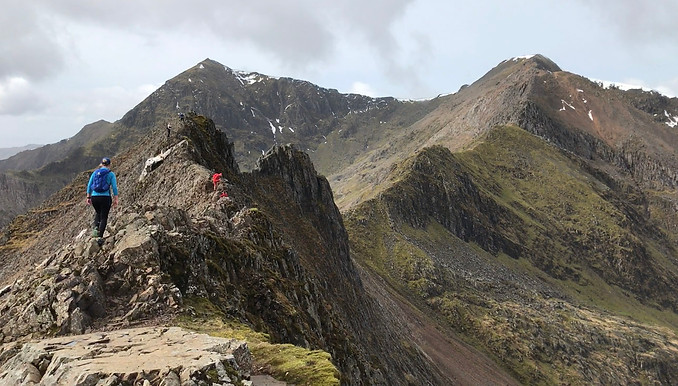
Crib Goch is a thrilling part of the Snowdon massif


How to prepare
Your preparation will depend on your chosen route. To approach Crib Goch with confidence, it’s prudent to have other Grade 1 ridge scrambles under your belt. Sharp or Striding Edge in the Lake District are wonderful objectives and, although slightly easier, are good preparation, as is Tryfan's North Ridge in Snowdonia's neighbouring Glyderau range.
To get into prime physical condition for Snowdon, get out there and go for some long hill walks or mountain hikes, ideally with a backpack. Snowdon is more accessible than Ben Nevis and Scafell Pike and is the least strenuous of the three by its easiest routes. It’s worth brushing up on your navigation while you are out hiking too, especially if you are heading for the quieter routes.

Tryfan North Ridge is a soaring line, a quite magnificent prospect
How to get to Snowdon
By train, Bangor station gets you close to Snowdonia. From there you can hop on a bus to Llanberis. The Snowdon Sherpa bus service runs around the foot of the massif and is an excellent way to access various start points. By car, the A55 coast road or the scenic A5 are the best approaches to the national park. Don’t expect to be able to park at Pen y Pass, as it is extremely busy, there are limited spaces and it’s ridiculously expensive anyway. Use the park and ride service, which will take you to Pen y Pass, at Nant Peris instead.
Where to stay
There’s an almost overwhelming choice of accommodation surrounding Snowdon. Llanberis is a good base, with gear shops and eateries (including the legendary Pete’s Eats) in which to pass the time on rainy days, while the picturesque village of Beddgelert is ideal for approaches from the south. There are four youth hostels spaced around the massif: Pen y Pass is perfect for the Miners’ Track, the Pyg Track and Crib Goch; Bryn Gwynant is placed at the trailhead for the Watkin Path and there’s no prizes for guessing which paths the Ranger and Llanberis hostels give you access to. There are also a number of well-managed campsites in the surrounding area.

Gwern Gof Uchaf, at the foot of Tryfan, is a good campsite and just a short drive from Snowdon
Wild camping is technically not permitted in Snowdonia, though it is generally tolerated if you camp responsibly and follow the Wild Camping Code. Away from the main trails, Snowdon’s glacially sculpted cwms make for some wonderful pitches, often sheltered from the elements. Cwm Tregalan, off the Watkin Path is suitably atmospheric, while an expedition into Cwm Glas to sleep by Llyn Glas under the cliffs of Crib y Ddysgl and Crib Goch is a rewarding experience.
What to pack
Don’t fall into the trap of relying on the summit café for supplies, as it may be closed, or if you have an accident before you get there, you’re stuck with no food and drink when you need them the most. Treat the café as a bonus and head onto the trails with around a litre of water (more on really hot days) and plenty of food. Drinking water straight from a stream on the world’s busiest mountain is not recommended unless you enjoy nursing a stomach bug.
Snowdon is a high mountain and the temperature at the top will be several degrees lower than in Llanberis. Rain shouldn’t come as a surprise either, this is North Wales after all. Be sure to carefully check a dedicated mountain weather forecast (such as the Mountain Weather Information Service) before setting out. A waterproof jacket and waterproof trousers should always be in your pack, as well as mid layers, a decent base layer, a hat and warm gloves. I always pack everything into individual dry bags in my pack. Oh, and don’t forget your sun cream in the warmer months.

Snowdon can be very wet indeed, so pack waterproof gear
While navigation technology is useful, particularly if you want to instantly pinpoint your exact location, though it is not a substitute for a map and compass and the skills to use them, with a combination of tech and traditional navigation tools the best way forward. Other key items include a head torch, a first aid kit and an emergency blanket.